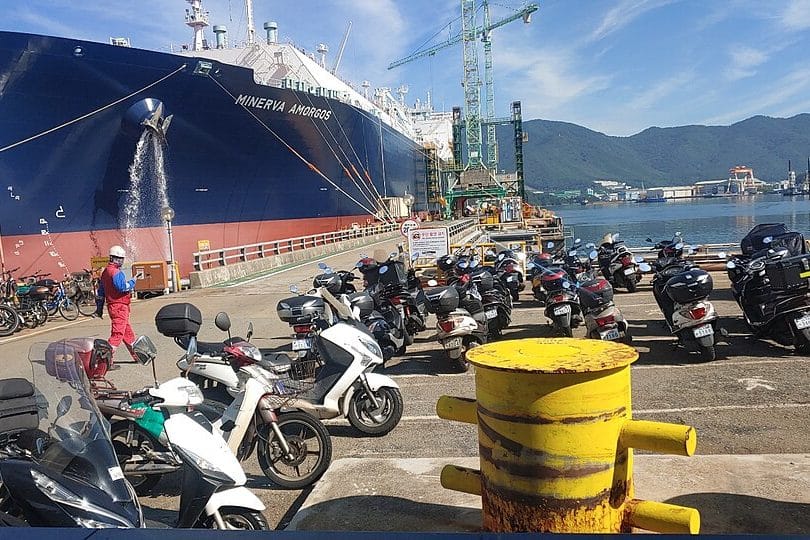
Berths at South Korea's three largest shipyards are booked solid deep into the next decade, and the reason sits in a single vessel type: the liquefied natural gas carrier. HD Hyundai Heavy Industries, Samsung Heavy Industries and Hanwha Ocean together control roughly two-thirds of the global order book for these ships, and executives at all three have started turning away buyers whose delivery timelines don't fit the queue. A vessel ordered today at Hanwha's Geoje yard is unlikely to reach the water before 2030.
A schedule filling years in advance
LNG carriers are floating cryogenic tanks, built to keep gas liquid at minus 162 degrees Celsius across weeks-long ocean crossings, and only a handful of yards worldwide can build them reliably. That scarcity has always given Korean shipbuilders pricing power during upswings, but the current cycle is unusual for its length. Samsung Heavy's order backlog for gas carriers alone stretched past 2028 as of its most recent disclosures, and Hanwha Ocean has said openly that it is prioritising repeat customers over new entrants trying to secure a slot.
Newbuild prices reflect the squeeze. A standard 174,000-cubic-metre LNG carrier that traded for around $186 million in 2020 now changes hands for $250 million or more, according to shipbroker Clarksons' benchmark series, and yards are no longer discounting to fill capacity the way they did after the 2016 downturn. HD Hyundai's marine arm reported an operating margin on shipbuilding that recovered from single digits to the mid-teens over the past two years, a shift executives have attributed directly to the gas-carrier mix rather than to container ships or tankers.
Where the orders are coming from
Two expansion waves are driving the queue. QatarEnergy's North Field expansion, which will lift the country's LNG export capacity from around 77 million tonnes a year toward 142 million tonnes by the end of the decade, has already generated more than 100 newbuild orders placed specifically to serve that project since 2020. Separately, a cluster of new export terminals along the US Gulf Coast — Plaquemines, Golden Pass and Port Arthur among them — needs its own dedicated fleet, since long-term offtake contracts typically require buyers to arrange shipping years before a terminal loads its first cargo.
- QatarEnergy-linked orders, split mainly among Korean yards with a smaller share going to China.
- US Gulf Coast offtakers, several of them Asian utilities and trading houses locking in ships alongside 20-year supply deals.
- Independent gas traders adding carriers speculatively, betting that charter rates stay elevated even after the newbuild wave delivers.
Not every order traces back to a single mega-project, and shipbrokers caution that some of the recent bookings are opportunistic rather than tied to a specific cargo contract — which is itself a sign of how confident owners have become about long-term gas demand.
Korea's edge over Chinese rivals
China's shipbuilding industry has spent the past decade closing the gap with Korea across nearly every vessel category, and in bulk carriers and container ships it has largely succeeded — Chinese yards now deliver more gross tonnage annually than Korean and Japanese yards combined. LNG carriers remain the exception. Hudong-Zhonghua, the state-owned yard that leads China's push into the segment, has built a growing number of carriers for domestic buyers such as China COSCO Shipping, but international owners still favour Korean yards for the containment systems that keep the cargo cold, a technology field where Korean firms hold deep patent portfolios built up over more than twenty years of construction experience.
That technical lead shows up in delivery reliability as much as in the hulls themselves. Buyers who need a vessel operating on schedule for a fixed-date offtake contract are, in practice, choosing between a handful of Korean slots and a wait list — Chinese capacity is growing, but insurers and charterers still price in a premium for newer yards without a multi-decade track record on this specific ship type.
The workforce bottleneck
Full order books have exposed a shortage the industry spent years trying to avoid discussing: there are not enough welders, pipefitters and hull technicians in South Korea's shipbuilding regions to run all three yards at capacity simultaneously. Geoje and Ulsan, the two cities that host most of the country's LNG carrier construction, have brought in thousands of workers from Vietnam, Indonesia and the Philippines under visa programmes expanded specifically for the sector since 2023. Hanwha Ocean has said its foreign workforce now accounts for close to a fifth of production staff at some sites, up from a marginal share five years earlier.
Unions have pushed back on wage growth lagging behind the industry's improved profitability, and a strike or extended labour dispute at any of the three majors would ripple through delivery schedules that customers are already treating as tight. None of the three companies has faced a major stoppage so far this year, but wage negotiations at Samsung Heavy's Geoje yard remain unresolved heading into the back half of 2026.
Greener ships, higher price tags
Roughly half of the LNG carriers on order across the industry now run on dual-fuel engines capable of burning the boil-off gas from their own cargo, cutting reliance on conventional bunker fuel and helping owners meet the International Maritime Organization's tightening carbon-intensity rules that took effect in phases from 2023. A smaller but growing slice of the order book, concentrated at HD Hyundai's Ulsan yard, involves ammonia-ready designs meant to run on a zero-carbon fuel that barely exists commercially yet — owners are paying a premium for optionality on a fuel supply chain that hasn't been built.
That bet only makes sense at scale for owners with balance sheets built to absorb it. Smaller trading houses have mostly stuck to conventional dual-fuel designs, leaving the ammonia-ready orders concentrated among a handful of shipping majors and the oil companies that also happen to be gas producers.
What it means for Asian LNG buyers
The tight shipbuilding market cuts two ways for the region's own gas importers. Japan's JERA, India's Petronet LNG and a string of Chinese state trading firms all rely on chartered capacity to move cargoes from Qatar, Australia and the United States, and freight rates for LNG carriers have climbed alongside newbuild prices — spot charter rates that sat below $40,000 a day during the 2023 oversupply have moved back above $70,000 a day on some routes as the fleet available for short-term hire has thinned out. Utilities locked into long-term charters signed before the current cycle are largely insulated, but any buyer needing spot tonnage on short notice is paying substantially more than it would have three years ago.
There is an upside for the countries hosting the yards. Shipbuilding remains one of South Korea's largest export categories, and the current order book has pulled the sector's contribution to the trade balance back to levels not seen since the mid-2010s super-cycle. Local suppliers of steel plate, marine engines and cryogenic containment materials are seeing knock-on demand as well, with several component makers in Geoje and Ulsan reporting order backlogs of their own stretching into 2027. For a country whose export mix leans heavily on semiconductors and autos, a second pillar recovering at the same time has not gone unnoticed by policymakers in Seoul.
Risks on the horizon
The obvious risk is timing. LNG shipping has a history of boom-bust cycles, and the last one ended when a wave of newbuild deliveries between 2019 and 2021 arrived just as charter rates were sliding, leaving owners with expensive ships and thin margins. Analysts at S&P Global Ratings have flagged the possibility of a similar glut once the current wave of roughly 300 carriers on order globally starts hitting the water in 2027 and 2028, particularly if Chinese LNG demand growth slows or new pipeline gas from Russia and Central Asia displaces some seaborne volumes.
Korean yards, for their part, argue that the current order book is different in kind — tied to specific, financed liquefaction projects rather than speculative capacity, and priced at levels that assume higher long-run construction costs rather than a return to the discounting of the mid-2010s. Whether that assumption holds will start to become clear as the first Gulf Coast terminals load their inaugural cargoes and the ships built to serve them start showing up in charter-rate data rather than in shipyard press releases.